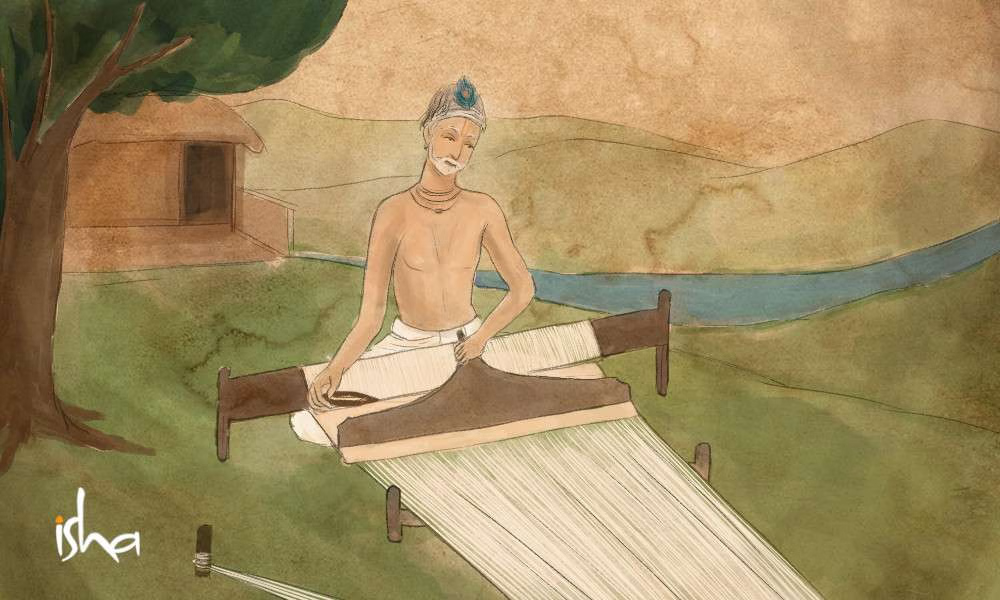
The Body as a Sacred Instrument
Kabir's evocative assertion that "this body is His dulcimer" invites us to perceive our physical existence as a divine instrument, finely tuned to express the music of the inner universe. In this metaphor, the body is not merely a vessel but a sacred tool through which the divine resonates. The stakes of this understanding are profound; it challenges us to recognize the interconnectedness of our physical selves with the spiritual realm, urging us to listen deeply to the melodies that arise from within.
As we delve into this quote, we uncover layers of meaning that speak to the essence of our being. Kabir, a luminary of the bhakti tradition, emphasizes the intimate relationship between the body and the divine. This relationship is not one of separation but of unity, where the strings of our existence vibrate in harmony with the cosmos. To grasp this teaching is to embark on a journey of self-discovery, where the body becomes a canvas for the divine symphony that plays through each of us.
The image / the metaphor
The imagery in Kabir's words is rich and evocative. The body is likened to a dulcimer, a stringed instrument known for its sweet, resonant sound. The act of drawing the strings tight suggests a process of tension and release, mirroring the human experience of struggle and joy. The choice of the verb "draws" implies an active engagement from the divine, as if God is intimately involved in the creation of our life's music. This imagery invites us to consider how our physical form is not merely a biological entity but a conduit for spiritual expression.
Diving deeper into the metaphor, we can see that the dulcimer represents not just the body but also the potential for creativity and expression inherent in each individual. The music that emerges is a reflection of our inner universe, a unique composition shaped by our experiences, emotions, and spiritual insights. In this light, the body becomes a sacred instrument, capable of producing a symphony that resonates with the divine. It challenges us to explore what melodies we are creating in our lives and how we can attune ourselves to the higher vibrations of existence.
In the speaker's tradition
Kabir's teachings are deeply rooted in the bhakti tradition, which emphasizes devotion and love for the divine as a path to spiritual realization. Concepts such as dharma, the moral order of the universe, and bhakti, the loving devotion to God, are central to understanding his perspective. In this context, the body as a dulcimer can be seen as an expression of kenosis, the self-emptying love that allows the divine to flow through us. This self-emptying is not a loss but a transformation, where the ego gives way to a greater sense of unity with the cosmos.
To further illuminate this teaching, we can reference the Bhagavad Gita, where Krishna speaks of the body as a temporary vessel for the eternal soul. In Chapter 2, Verse 13, it is stated that just as the body undergoes changes from childhood to old age, the soul remains unchanged. This perspective aligns with Kabir's metaphor, suggesting that while our physical forms may be transient, the music that arises from our inner universe is eternal, echoing the divine presence that permeates all existence.
Living the teaching
Consider a modern scenario where this teaching resonates: a musician preparing for a performance. As they tune their instrument, they engage in a process of mindfulness, becoming aware of the subtle adjustments needed to create harmonious sounds. In this moment, the musician embodies Kabir's teaching, recognizing their body as a dulcimer, an instrument through which the divine music of creativity flows. This practice of tuning not only applies to music but can extend to any creative endeavor, reminding us to listen to the inner melodies that guide our actions.
Another application of this teaching can be found in the realm of relationships. Imagine a moment of conflict with a loved one, where emotions run high and communication falters. By embodying the understanding that our bodies are instruments of divine expression, we can approach the situation with a sense of calm and openness. Instead of reacting from a place of hurt, we can listen deeply to the music of our emotions and the underlying needs of the other person. This shift in perspective allows us to create a more harmonious interaction, transforming potential discord into a beautiful exchange of understanding and love.
A reflection
As we reflect on Kabir's profound insight, we are invited to consider: What music is my body creating in this moment? This contemplative question encourages us to pause and listen to the inner universe that resides within us. It challenges us to explore how our thoughts, emotions, and actions resonate with the divine, and how we can attune ourselves to produce a symphony that reflects our highest selves. In this way, we can embrace the sacredness of our existence and the beauty of the music that is uniquely ours to share.



Join the BrightStar Community
Stay connected with daily inspiration, event announcements, and community wisdom